MotoGP rider Marco Simoncelli died exactly a week after Dan Wheldon, and while the tributes poured in for the 24-year-old following his death in Malaysia on Sunday there were calls to investigate the circumstances as the chairman of the Sepang circuit admitted safety in the sport could never be 100 per cent guaranteed.
The 24-year-old Italian lost control of his Honda at turn 11 four minutes into the race, but his bike regained partial grip and swerved across the track, straight into the path of American Colin Edwards and Valentino Rossi of Italy.
MotoGP race director Paul Butler pledged to investigate the circumstances surrounding the accident while Sepang circuit chairman Mokhzani Mahathir voiced his condolences and said it was unfortunate that a death occurred for the first time since the circuit opened in 1999.
(excerpt from wikipedia)
Simoncelli was involved in an accident with Colin Edwards and Valentino Rossi during the 2011 Malaysian GP at the Sepang International Circuit. In fourth position during lap two, Simoncelli's bike veered across the track and straight into the path of Edwards and Rossi. Edwards was injured with a dislocated shoulder, while Simoncelli lay still on the track after the crash, his helmet having come off during the incident. The race was immediately red-flagged. He was taken by ambulance to the circuit's medical centre, but at 16:56 local time it was announced that he had died from his injuries. Later, at a press conference involving members of the MotoGP Race Direction, Medical Director Michele Macchiagodena said that Simoncelli sustained "a very serious trauma to the head, to the neck and the chest", and was administered cardiopulmonary resuscitation for 45 minutes.
If you want to be competitive in the sport of kart racing, you’re going to need a competitive kart engine. You can spend a lot on a top of the line racing chassis, but if the engine isn't built to win, it may all be in vain. There are two "brands" of go kart engines used mainly in competitive racing which include Honda and Briggs engines. Karts used today are of different types with variety of specifications. The main component of a kart is the engine which makes it race on the track. The karts used in racing are either with 2-stroke or 4-stroke engines.
4-stroke engines can be a standard air-cooled engine which develops a power of about 5 to 20 HP. They run at around 11,000 rpm, and are manufactured specifically for karting. Briggs & Stratton and Honda are the major and widely used manufacturing brand of such engines. Yamaha, TKM, Biland or Aixro which is a wankel engine are some of the powerful four-stroke engines manufacturing brands which are not used widely but are known for the power they offer which ranges from 15 HP to 48 HP. These brands are used in some classes of two-strokes National Championships.
2-stroke kart engines are built and developed by dedicated manufacturers like WTP, Vortex, Titan, REFO, TKM, Yamaha and Rotax. Rotax is a well known engine type and there is a Rotax Max Championship which is held every year for this class of engine. 2-stroke kart engines develop power from about 8 HP for a single-cylinder 60 cc unit (MiniROK by Vortex) to 90 HP for a twin 250 cc. The most popular categories are those using the Touch-and-go (TAG) 125 cc units. The recent 125 cc KF1 engines are electronically limited at 16,000 rpm. Now-a-days water-cooled engines are used but when the sport of karting originated, air cooled engines dominated the tracks.
The Builder
If you purchase a kart engine out of a box from a dealer, chances are it will not be competitively race ready. In order to have an engine brought up to par with your competitors, you will have to find an engine builder in your area to do so. They will put your engine on a dynamometer, which will measure the torque and rotational speed (rpm) from which power produced by the engine can be calculated. The builder will then tweak the engine to produce the highest amount of torque and rpm within specifications to make your engine as fast as possible.
A 4-stroke engine can cost anywhere above INR. 20,000 and a 2-stroke engine can be above INR. 1,60,000. Well, the cost of having the engine built competitively by an engine builder can add to that cost. Overall it is a good investment for a racing engine however.
The Components
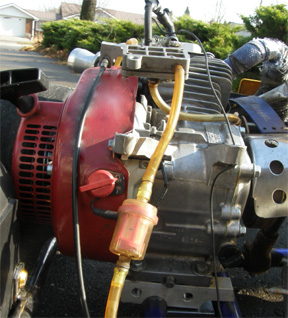
The specifics of a Honda karting engines include:
- Overhead valve single cylinder
- Spark Plugs
- Wet, multi-plate, centrifugal clutch system
- Forced air cooling system
- The recoil or electric start system
- Fuel tank
Upkeep
To keep your engine running efficiently from race to race, there are a few things you should do at the end of each race day before you pack away.
- Inspect your spark plug to ensure nothing has moved or been damaged during the event. For optimized engine performance, it is advisable to replace your spark plug once a year.
- Remove any used oil from the engine after race day before storing. You should change your oil generally every 20-30 minutes of track racing. This should usually last you one full race day depending on how many races you complete in a day.
- If you are going to keep the kart stationary for more than 30 days without racing, you should remove all the gasoline from the engine. Storing gasoline can cause hard starting and poor engine performance.