Pages

Showing posts with label rotax. Show all posts

Rotax Euro Challenge 2011

Check out the Rotax Euro Challenge 2011 held in Pekan on the Indrapura Karting Circuit. Results for the championship are follows:

Rotax Senior Max
1. Kasper Jensen (DEN) - Kosmic / PB Kart Race
2. Ben Cooper (GBR) - Birel / Kalman Motorsport
3. Mathias Smith (DEN) - Kosmic / DMT Racing DK


Rotax Junior Max
1.  Ukyo Sasahara (JAP) - Kosmic / Paul Carr Racing
2. Nathan Harrison (GBR) - Tony Kart / Strawberry Racing
3. Philip Morin (SWE) - Kosmic / Paul Carr Racing


Rotax Max Masters
1. Mikko Laine (FIN) - Parolin / Formula K Belgium
2. Jean-Louis Capliuk (GER) - Praga / JLC Racing Team
3. Christophe Adams (BEL) - Kosmic / Sporting Kart Competition


Rotax DD2
1.  Simas Juodvirsis (LTU) - Gillard / RKV Racing by DFK
2. Christof Huibers (BEL) - Kosmic / Paul Carr Racing
3. Mathias Detige (BEL) - Gillard / DFK Racing Team


Rotax DD2 Masters
1. Florent Lambert (GBR) - Topkart / Tatum Racing
2. Tamsin Germain (GBR) - Maddox / DG Racing
3. Christophe Adams (BEL) - Kosmic / Sporting Kart Competition


Keep checking our blogs for updates.

Toodles.

Chetan Vengurlekar
Basic Information - Transmission and Data Aquisition


Transmission
We have discussed about a basic kart and some information in our previous posts. Today, we will see how the transmission of a kart is different from a normal car and how it withstands all the pressure while racing on the tracks.
A kart do not have differential. As there is no differential, one tyre on the rear axle slides while cornering. The cars which we use in our daily lives, have a differential on the rear axle which helps the vehicle to take perfect turns on the road and helps tyre wear as well.

This condition is taken care while designing the kart. The chassis is made so that the inside rear tyre lifts up slightly when the kart turns the corner. This allows the tire to lose some of its grip and slide or lift off the ground completely.


Like in cars, power is transmitted from engine to the rear axle by the means of a chain arrangement. The chain drives the power from engine to the axle sprocket which in turn drives the rear axle and the rear wheels. The power ratio between the engine and the axle sprocket has to be adapted according to track configuration so that the engines gives it’s best performance on the track.

When karting was born, there were direct drives only. But as science grew direct drives proved to be inconvenient which led to the centrifugal clutch for the club level classes. For example, in Rotax Max championship, dry centrifugal clutches are used. Since then it has become the norm as the top international classes have switched to 125 cc clutched engines. The date from which this was effective is January 2007.


Data acquisition

Kart racing is popularizing because of the bottle-neck competition within micro-seconds. The results can’t be finalized using a human being with a video footage of the live race, so various devices are used to measure the precision. Several of these systems have been developed specially for kart racing; to measure the RPM, timing of laps (including sectors) and number of laps, best lap, cooling system temperature and sometime speed or even gear for shifter karts.


These systems allow the driver to monitor from a display fixed on the steering wheel. Some of those systems are able to record (logging) laps data from the sensors, allowing replay of an entire running session and/or direct download to a personal computer equipped with data analysis software. More sophisticated systems allow for more information such as lateral and longitudinal acceleration (or G-force), throttle position, steering wheel position, brake pressure, etc.


Keep checking our blogs for updates.

Toodles.

Chetan Vengurlekar

Basic Information - Engine

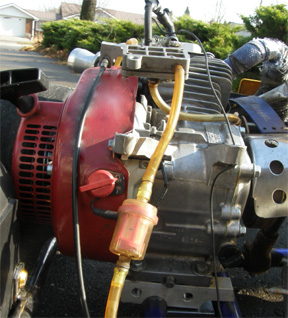
If you want to be competitive in the sport of kart racing, you’re going to need a competitive kart engine. You can spend a lot on a top of the line racing chassis, but if the engine isn't built to win, it may all be in vain. There are two "brands" of go kart engines used mainly in competitive racing which include Honda and Briggs engines. Karts used today are of different types with variety of specifications. The main component of a kart is the engine which makes it race on the track. The karts used in racing are either with 2-stroke or 4-stroke engines.
 4-stroke engines can be a standard air-cooled engine which develops a power of about 5 to 20 HP. They run at around 11,000 rpm, and are manufactured specifically for karting. Briggs & Stratton and Honda are the major and widely used manufacturing brand of such engines. Yamaha, TKM, Biland or Aixro which is a wankel engine are some of the powerful four-stroke engines manufacturing brands which are not used widely but are known for the power they offer which ranges from 15 HP to 48 HP. These brands are used in some classes of two-strokes National Championships.
 
2-stroke kart engines are built and developed by dedicated manufacturers like WTP, Vortex, Titan, REFO, TKM, Yamaha and Rotax. Rotax is a well known engine type and there is a Rotax Max Championship which is held every year for this class of engine. 2-stroke kart engines develop power from about 8 HP for a single-cylinder 60 cc unit (MiniROK by Vortex) to 90 HP for a twin 250 cc. The most popular categories are those using the Touch-and-go (TAG) 125 cc units. The recent 125 cc KF1 engines are electronically limited at 16,000 rpm. Now-a-days water-cooled engines are used but when the sport of karting originated, air cooled engines dominated the tracks.


The Builder
If you purchase a kart engine out of a box from a dealer, chances are it will not be competitively race ready. In order to have an engine brought up to par with your competitors, you will have to find an engine builder in your area to do so. They will put your engine on a dynamometer, which will measure the torque and rotational speed (rpm) from which power produced by the engine can be calculated. The builder will then tweak the engine to produce the highest amount of torque and rpm within specifications to make your engine as fast as possible.
A 4-stroke engine can cost anywhere above INR. 20,000 and a 2-stroke engine can be above INR. 1,60,000. Well, the cost of having the engine built competitively by an engine builder can add to that cost. Overall it is a good investment for a racing engine however.
The Components
The specifics of a Honda karting engines include:
- Overhead valve single cylinder
- Spark Plugs
- Wet, multi-plate, centrifugal clutch system
- Forced air cooling system
- The recoil or electric start system
- Fuel tank


Upkeep
To keep your engine running efficiently from race to race, there are a few things you should do at the end of each race day before you pack away.
- Inspect your spark plug to ensure nothing has moved or been damaged during the event. For optimized engine performance, it is advisable to replace your spark plug once a year.
- Remove any used oil from the engine after race day before storing. You should change your oil generally every 20-30 minutes of track racing. This should usually last you one full race day depending on how many races you complete in a day.
- If you are going to keep the kart stationary for more than 30 days without racing, you should remove all the gasoline from the engine. Storing gasoline can cause hard starting and poor engine performance.


Keep checking our blogs for updates.

Toodles.


Chetan Vengurlekar