Pages

Showing posts with label ardor racing. Show all posts

Safety in Moto GP is never 100% guaranteed - Sepang circuit chairman


MotoGP rider Marco Simoncelli died exactly a week after Dan Wheldon, and while the tributes poured in for the 24-year-old following his death in Malaysia on Sunday there were calls to investigate the circumstances as the chairman of the Sepang circuit admitted safety in the sport could never be 100 per cent guaranteed.


The 24-year-old Italian lost control of his Honda at turn 11 four minutes into the race, but his bike regained partial grip and swerved across the track, straight into the path of American Colin Edwards and Valentino Rossi of Italy.


MotoGP race director Paul Butler pledged to investigate the circumstances surrounding the accident while Sepang circuit chairman Mokhzani Mahathir voiced his condolences and said it was unfortunate that a death occurred for the first time since the circuit opened in 1999.


(excerpt from wikipedia)
Simoncelli was involved in an accident with Colin Edwards and Valentino Rossi during the 2011 Malaysian GP at the Sepang International Circuit. In fourth position during lap two, Simoncelli's bike veered across the track and straight into the path of Edwards and Rossi. Edwards was injured with a dislocated shoulder, while Simoncelli lay still on the track after the crash, his helmet having come off during the incident. The race was immediately red-flagged. He was taken by ambulance to the circuit's medical centre, but at 16:56 local time it was announced that he had died from his injuries. Later, at a press conference involving members of the MotoGP Race Direction, Medical Director Michele Macchiagodena said that Simoncelli sustained "a very serious trauma to the head, to the neck and the chest", and was administered cardiopulmonary resuscitation for 45 minutes.

Chetan Vengurlekar


Legend completes his 20 year journey

Twenty years on from his sensational debut as a virtually unknown Formula One driver, Michael Schumacher has this week insisted that he will race with Mercedes in 2012 despite widespread rumors that he is set to quit. Michael Schumacher is set to host a small anniversary party at the track next Saturday evening, inviting the "whole paddock" for a drink.

The seven-time World Champion made his Formula One debut at the Belgian Grand Prix back in 1991 with the Jordan team. One year later, driving for Benetton, Schumacher claimed his first race victory at the track.
"It's a great moment for me, it all started in Spa where there have been very important moments," he told Auto Moto und Sport.

"Despite some funny rumors and stupid untruthful stories, I keep repeating myself that you will have to see me in 2012, whether you like it or don't like it," the Mercedes website quoted him saying.


1992 Belgian GP
A year after his debut, Schumacher won his first race taking the famed Eau Rouge corner in his customary aggressive style. Starting third, behind Ayrton Senna and Nigel Mansell, he left both in his wake.

1994 Australian GP
A point separating Schumi and Damon Hill going into the final race of the season. The German was leading but Hill tried to pass him, they collided ending both their races. Schumi walked away with the title

1997 European GP
It was 1994 all over again, with a slightly different end. Schumi was a point ahead of Jacques Villeneuve, but this time things backfired as he rammed his car into Villeneuve's. The Canadian was unscathed, Schumi's race, title hopes over

1998 Hungarian GP
With a car that was vastly inferior to Hakkinen's McLarren, Schumi and Ross Brawn's three-stop strategy worked like a charm. As much as the plan, it was blistering fast execution that won them the race

2004 Belgian GP
It was only fitting that Schumi crowned his most dominant season as his favorite hunting ground. After winning 12 of the first 13 races that season, a second place finish was enough to seal Schumacher's record seventh drivers' title


Keep checking our blogs for updates.

Toodles.

Chetan Vengurlekar

Rotax Euro Challenge 2011

Check out the Rotax Euro Challenge 2011 held in Pekan on the Indrapura Karting Circuit. Results for the championship are follows:

Rotax Senior Max
1. Kasper Jensen (DEN) - Kosmic / PB Kart Race
2. Ben Cooper (GBR) - Birel / Kalman Motorsport
3. Mathias Smith (DEN) - Kosmic / DMT Racing DK


Rotax Junior Max
1.  Ukyo Sasahara (JAP) - Kosmic / Paul Carr Racing
2. Nathan Harrison (GBR) - Tony Kart / Strawberry Racing
3. Philip Morin (SWE) - Kosmic / Paul Carr Racing


Rotax Max Masters
1. Mikko Laine (FIN) - Parolin / Formula K Belgium
2. Jean-Louis Capliuk (GER) - Praga / JLC Racing Team
3. Christophe Adams (BEL) - Kosmic / Sporting Kart Competition


Rotax DD2
1.  Simas Juodvirsis (LTU) - Gillard / RKV Racing by DFK
2. Christof Huibers (BEL) - Kosmic / Paul Carr Racing
3. Mathias Detige (BEL) - Gillard / DFK Racing Team


Rotax DD2 Masters
1. Florent Lambert (GBR) - Topkart / Tatum Racing
2. Tamsin Germain (GBR) - Maddox / DG Racing
3. Christophe Adams (BEL) - Kosmic / Sporting Kart Competition


Keep checking our blogs for updates.

Toodles.

Chetan Vengurlekar

Development in Indian Racing


India is eyeing to grab the global attention with its first Indian Grand Prix at the Jaypee Sports International City in Greater Noida this October. This Grand Prix will surely open a few doors for the motorsport industry in India.

The track which is being built at Noida is of international standards and investors have poured a hell lot of money to make it happen. The worth is said to be of around INR. 1500 crore. But the total investment cost is somewhere near INR 10,000 crore. With such a big investment, F1 is not only the sport which will be organized on this circuit.

Machdar Motorsport has initiated a new kind of racing in India known as The I1 Super Series, which starts in December and will be an Asian event spanning across India, Malaysia, Indonesia and Dubai. Even before the F1, we can see that the growth in Indian Racing Fraternity has already started.

But when someone goes up on a “status” ladder, he has to climb on other people to surpass them. And as we see that immense money is involved in this sport, there is ought to be involvement of industrial biggies. When big people are involved somewhere something has to go against the law. Today when I was reading the local newspaper, it was brought to my attention that the land on which the 5.6 km circuit is being built, once belonged to the farmers but they had to give up their land to the government. The authorities told the farmers that government needed the land for public purposes but in reality it was sold to some private developer who built the circuit. Now the farmers are protesting on terms of some law in the IPC. This is not a fair way to start something anew but when someone bears a loss, the other gains profit. The 40 villages that lost their lands to the project held a mahapanchayat today. Hope that the result was in the benefit of everyone.

India surely is on the verge of becoming a super power and the motorsport industry is just another foot step to the success. With F1 and I1 starting off this year, India will be known for yet another sport to be famous for. We already have a team in the F1, Force India, which is trying to rope in young talent to be a part of the international event and there is I1 which is so promising for Indian drivers that it will re-open doors for their international carrier. I hope that this season of F1 happens safe and sound in India and may the day come when Indians will organize an event which will showcase our own talent and the world will want to be a part of us.

Keep checking our blogs for updates.

 Toodles.

The Amazing Race - Kolhapur


Last weekend I was on a trip to Kolhapur where I was to see the race track. I went there with my friend and business partner, Yatin, so that we won’t be bored on the trip. We boarded the bus from Sion at 10:30 pm and were on the most awesome trip. We already had our dinner so as soon as we boarded the bus, went to sleep. The conductor woke us up at around 6:30 am as we were approaching Kolhapur. We got off from the bus and I thought I was in the middle of nowhere. Kolhapur is a well known place but the deserted town in the early hours made me unhappy about my visit.

I called one of my friends who was staying in some hotel in Kolhapur. He gave us the address and we boarded the auto-rickshaw. I knew the morning was cursed when the auto-rickshaw driver over-charged us for the trip. But I gathered my conscience and went to meet my friend. He greeted us with open arms. We freshened up and were out for our breakfast. We stopped at McDonalds and had our fill. We went to the race track from there straight. We were in a Maruti Omni which is almost a scrap material. The other guys were in a Verna who was driven by a driver of a friend. To make the morning interesting my friend and the driver got into a street race for fun. The Verna driver was boasting as his engine was more powerful than ours but little he was aware that my friend who was driving our car is a national kart racing champion. The rage of the race was so enthralling that all of us were gushed with a rush of adrenaline. All of us were hoping that our respective car should win. It was a very narrow race between the two cars. Finally as we approached the race track, the race had reached a point where no one of us were able to guess which car would win, when my friend took a very narrow shortcut and  overpowered the other driver. The driver was transfixed at my friend’s move but he accepted his defeat with a smile on his face.

When our little race thingy was over we got to our work. All I saw in the pit area was 3-4 mechanics who were assembling some karts dedicatedly for the testing session. My friend who is a race driver started the testing session with the drivers. After about three hours of rigorous practice session, we took a lunch break. As we were done with our lunch, the rain started pouring on the Kolhapur land. All the drivers were nervous that they have to cancel their remaining training session due to the rains as there were puddles on the track. So, we volunteered to clean the mess on the track. We all got rental karts and started driving them on the track. We were having fun as we splashed water on one another with our speeding karts. Some tried to topple each other on a curve and some tried to push the other off the track. We were having a fun time when at the last lap, Yatin lost his control over the kart and went off the tracks and into the untrimmed grass. This was the only accident on that day. After the “recreational race”, we all started our journey back home. The drivers left early and we started to pack things up on the track. When everything was sorted on the track, the mechanics were paid their daily wages. After all the mechanics were gone, we left the track for our hotel. When we got back to our room, we freshened up and packed our luggage. We were content with the total experience and were very glad to be a part of the testing session. We boarded the bus for home at 9:30 pm before which we ate a light meal. We reached Thane at 5:15 am.

I reached home by 6:30 am and went to sleep as the 3-4 hours of sleep wasn’t enough for me. I dozed off and got up again at 11:00 am when I saw a series of missed calls on my phone. It was my friend, Jerald. When I called up he told me that some friend of his, who worked in a petrol company wanted to sponsor our team. This trip was so beneficial that it actually grossed us some sponsors. The trip was truly awesome and all of us were content with the returns.

Keep checking our blogs for updates.

Toodles.

Chetan Vengurlekar

Basic Information - Transmission and Data Aquisition


Transmission
We have discussed about a basic kart and some information in our previous posts. Today, we will see how the transmission of a kart is different from a normal car and how it withstands all the pressure while racing on the tracks.
A kart do not have differential. As there is no differential, one tyre on the rear axle slides while cornering. The cars which we use in our daily lives, have a differential on the rear axle which helps the vehicle to take perfect turns on the road and helps tyre wear as well.

This condition is taken care while designing the kart. The chassis is made so that the inside rear tyre lifts up slightly when the kart turns the corner. This allows the tire to lose some of its grip and slide or lift off the ground completely.


Like in cars, power is transmitted from engine to the rear axle by the means of a chain arrangement. The chain drives the power from engine to the axle sprocket which in turn drives the rear axle and the rear wheels. The power ratio between the engine and the axle sprocket has to be adapted according to track configuration so that the engines gives it’s best performance on the track.

When karting was born, there were direct drives only. But as science grew direct drives proved to be inconvenient which led to the centrifugal clutch for the club level classes. For example, in Rotax Max championship, dry centrifugal clutches are used. Since then it has become the norm as the top international classes have switched to 125 cc clutched engines. The date from which this was effective is January 2007.


Data acquisition

Kart racing is popularizing because of the bottle-neck competition within micro-seconds. The results can’t be finalized using a human being with a video footage of the live race, so various devices are used to measure the precision. Several of these systems have been developed specially for kart racing; to measure the RPM, timing of laps (including sectors) and number of laps, best lap, cooling system temperature and sometime speed or even gear for shifter karts.


These systems allow the driver to monitor from a display fixed on the steering wheel. Some of those systems are able to record (logging) laps data from the sensors, allowing replay of an entire running session and/or direct download to a personal computer equipped with data analysis software. More sophisticated systems allow for more information such as lateral and longitudinal acceleration (or G-force), throttle position, steering wheel position, brake pressure, etc.


Keep checking our blogs for updates.

Toodles.

Chetan Vengurlekar

Basic Information - Engine

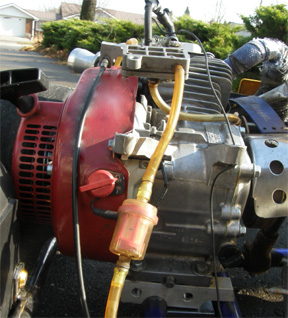
If you want to be competitive in the sport of kart racing, you’re going to need a competitive kart engine. You can spend a lot on a top of the line racing chassis, but if the engine isn't built to win, it may all be in vain. There are two "brands" of go kart engines used mainly in competitive racing which include Honda and Briggs engines. Karts used today are of different types with variety of specifications. The main component of a kart is the engine which makes it race on the track. The karts used in racing are either with 2-stroke or 4-stroke engines.
 4-stroke engines can be a standard air-cooled engine which develops a power of about 5 to 20 HP. They run at around 11,000 rpm, and are manufactured specifically for karting. Briggs & Stratton and Honda are the major and widely used manufacturing brand of such engines. Yamaha, TKM, Biland or Aixro which is a wankel engine are some of the powerful four-stroke engines manufacturing brands which are not used widely but are known for the power they offer which ranges from 15 HP to 48 HP. These brands are used in some classes of two-strokes National Championships.
 
2-stroke kart engines are built and developed by dedicated manufacturers like WTP, Vortex, Titan, REFO, TKM, Yamaha and Rotax. Rotax is a well known engine type and there is a Rotax Max Championship which is held every year for this class of engine. 2-stroke kart engines develop power from about 8 HP for a single-cylinder 60 cc unit (MiniROK by Vortex) to 90 HP for a twin 250 cc. The most popular categories are those using the Touch-and-go (TAG) 125 cc units. The recent 125 cc KF1 engines are electronically limited at 16,000 rpm. Now-a-days water-cooled engines are used but when the sport of karting originated, air cooled engines dominated the tracks.


The Builder
If you purchase a kart engine out of a box from a dealer, chances are it will not be competitively race ready. In order to have an engine brought up to par with your competitors, you will have to find an engine builder in your area to do so. They will put your engine on a dynamometer, which will measure the torque and rotational speed (rpm) from which power produced by the engine can be calculated. The builder will then tweak the engine to produce the highest amount of torque and rpm within specifications to make your engine as fast as possible.
A 4-stroke engine can cost anywhere above INR. 20,000 and a 2-stroke engine can be above INR. 1,60,000. Well, the cost of having the engine built competitively by an engine builder can add to that cost. Overall it is a good investment for a racing engine however.
The Components
The specifics of a Honda karting engines include:
- Overhead valve single cylinder
- Spark Plugs
- Wet, multi-plate, centrifugal clutch system
- Forced air cooling system
- The recoil or electric start system
- Fuel tank


Upkeep
To keep your engine running efficiently from race to race, there are a few things you should do at the end of each race day before you pack away.
- Inspect your spark plug to ensure nothing has moved or been damaged during the event. For optimized engine performance, it is advisable to replace your spark plug once a year.
- Remove any used oil from the engine after race day before storing. You should change your oil generally every 20-30 minutes of track racing. This should usually last you one full race day depending on how many races you complete in a day.
- If you are going to keep the kart stationary for more than 30 days without racing, you should remove all the gasoline from the engine. Storing gasoline can cause hard starting and poor engine performance.


Keep checking our blogs for updates.

Toodles.


Chetan Vengurlekar

Basic Information - Tyres

The wheel and tyres of a kart are much smaller than those used in a normal car. Tyres are mounted on the rim which is on the axle of the kart. Rims are made of magnesium alloy or aluminium. Tyres can support cornering forces in excess of 2 G (20 m/s²), depending on chassis, engine, and motor setup. These tyres are specially designed for fast paced racing. They help you to stay on tracks and around tight corners without going off-track. The figure shows the nomenclature of a kart tyre. When you buy a kart tyre on an international level, the specifications are given in the order of tread width, overall diameter and rim diameter.

 
Types of tyres

There are two types of racing tyres viz. slick and grooved tyres. Slick tyres are used for dry racing and grooved tyres are used for wet/rainy racing.

Slicks
There are various brands of slick racing tyres to choose from which include Dunlop, Vega and Bridgestone to name a few. These kart wheels or tyres are specially designed to make as much contact as possible with the track underneath of you to ensure excellent grip and a precise centre of gravity for the kart. This helps the kart to stick on the track and nail those corners increasing speed. The tread is made of a thin layer of rubber that includes a various amount of compounds that make the tyre have either, really good grip or have a greater resistance to wear. Slick kart tyres come in many different compounds, from very soft (maximum grip) to very hard (amusement and rental karts, less grip but long life span).


Rains
Rain tyres are specially designed to help you race in the rain. Some people hate it, but with the right knowledge and some practice racing in the rain can be just as fun as in the sun. They are grooved and are made of soft compound. They are also narrower than slicks. Not all racing classes allow rain tyres. The grooves in the rain tyres reduce the amount of contact area that a slick tyre would give and therefore help keep you on the track. They are constructed the same way as slicks in the way that they have a compounded rubber tread surface that can again be made for more grip or resistance to wear depending on the compound type.


Tyre Pressures
What is the pressure at which a kart should ideally run? This can be of personal preference to some racers. Generally, on an average day when the track is dry and you have your slicks on, a good pressure to start at is around 14 psi to 16 psi. Once you get out racing on the track your tyres will heat up and the pressure inside will build. Depending on how hot it is outside you can expect the pressure to rise between 1 psi to 3 psi. You can then add or release pressure depending on how you feel out on the track. Some people also split up the pressures and add more on the front kart wheels or tyres and less on the back or visa-versa to improve their cornering. It’s a good habit to start checking your tyres before you go out on the track each time. This ensures your pressures are good and that you don’t have a tyre malfunction like a leak causing a flat tyre.
If you are racing with rain tyres, you may want to increase the pressure by about 1 psi to 5 psi. Once the track dries out though, ensure you change back to slicks, as soon as possible. If you don’t, your rain tyres could get worn out quickly.
Tyre Wear
How do you know when it’s time to change your kart wheels or tyres? If you have been racing for a while, you can feel when your tyres need to be replaced. You won’t feel as smooth through the corners which can affect your speed and you may even feel in less control of the kart because it won’t “stick” to the track as well. A good indicator is the kart tyre itself. On slick tyres and wet/rain tyres there are small holes that indicate how much rubber has been worn off. When these holes get shallow it’s an indication that the rubber has been worn out and you probably have to change tyres.

Keep checking our blogs for updates.

Toodles.

Chetan Vengurlekar
Basic Information - Chassis

A chassis is the most important part of a kart as all the mountings are mounted on it. Chassis are easily available online as there are very few distributors in India. The racing kart chassis is specially designed to withstand the top speeds of go karts as well as the immense amount of pressure being put on the frame when taking corners at top speed. These frames can cost anywhere from Rs. 1.75 lacs to Rs. 5 lacs brand new.

Chassis

A chassis is built on steel hollow tubes. They do not have any kind of suspension system, so they have to work as a suspension. Also they should be stiff enough not to break down on a turn. The stiffness of a chassis enables different handling characteristics for different circumstances. Typically, for dry conditions a stiffer chassis is preferable, while in wet or other poor traction conditions, a more flexible chassis works better. The best chassis allow for stiffening bars at the rear, front and side to be added or removed according to race conditions. Professionally raced karts typically weigh 75 kg to 79 kg, without a driver.


A basic chassis of a kart looks like the figure shown above. Mountings such as engine, fuel tank, brakes, etc. are later assembled on the chassis.

'Caged', 'Open', ‘Straight’ and ‘Offset’ are types of chassis available in the USA. All CIK-FIA approved chassis are 'Straight' and 'Open'. Caged karts have a roll cage surrounding the driver; they are mostly used on dirt tracks. Open karts have no roll cage and are mostly used in world championships. In Straight chassis the driver sits in the centre; they are used for sprint racing. In Offset chassis the driver sits on the left side. Offset chassis are used for left-turn-only speedway racing. Karts used in Asian and European championships are always Open chassis.

Let us discuss the mountings, which are fitted on the chassis, in brief.

Rims and Hub


The hubs are attached to the ends of the axle. In the figure above, there are only rims, which are bolted onto the hubs. Obviously, during a race, these rims will have tires on them. Rims are casted in a number of different composites including magnesium and aluminium. Hubs can also be made of different materials. Therefore, various brands differ in durability and weight of the kart.

Seat Mounts


Figure shows the position of a seat mount on a chassis. The steering wheel is attached to the front axle. The position of a kart driver is such that the steering wheel is in between his legs. This gives a better steering experience as the position of the driver is in the centre of the kart.

Throttle and Brake Peddles


Each of these peddles are located at the front of a racing kart. The brake is located on the left and the throttle is located on the right. It is noted that while driving a kart, these peddles should never be used at the same time for safety reasons. Braking is achieved by a disc brake mounted on the rear axle. Front disc brakes are increasingly popular; however, certain classes do not allow them.

Racing Kart Manufacturer

Avanti, Birel, CRG, FA Kart, Gillard, Intrepid, Kosmic, Tony Kart, Trulli and Zanardi are some of the famous and widely used European manufacturer of racing kart chassis.

Keep checking our blogs for updates.

Toodles.

God made man, Man made SPEED, SPEED made man mad

                What do men want? It is said that men have only two feelings; they can be hungry or horny; sometimes, at the same time. If you make a sandwich for a man after having sex, then you are the most intelligent woman on the face of this planet. On the other hand, women are the most complex species. They have multiple feelings at the same time, they can multi-task and they can juggle all kinds of responsibilities with sheer ease. I think, that’s the reason why god offered them with a special gift, multiple orgasms. And it has proved beneficial on their counter-part.

As this is a male dominating society with tons of male chauvinists around us, they try to compete with the female organisms of our species. How can a woman handle so many responsibilities or multi-task in the company of so many desirable men? So the male organisms of the species, found out a new feeling; the adrenaline rush feeling. And to pump it up man started competing with machine. But machines are quick and very responsive as compared to any human being till date. So man, started to compete other men with the use of a combination of man and machine. And hence, the sport of motor racing was born.

Speed is the most addictive drug known to mankind. It can make you or break you. Some recognized faces who made it big with speed are Michael Schumacher on the international front and Narian Karthikeyan who is a nationwide fame for securing a position in the prestigious Formula One Championship. As we only remember the people who make it big and the people who are super successful, there are no names in the list of people who died trying to be a biggie in terms of speed. But again, there are my acquaintances who are trying to make it to the grand league but fall out due to various reasons.

If you are the male species of homo sapiens sapien, then you ought to have the zeal for speed. It’s like if you are a female species of homo sapiens sapien, then you ought to have multiple orgasms. It’s like; you can have as many orgasms as you want with your counterpart if you can cruise a vehicle above the standard speed limits with perfect control and handling.

The fastest automobile ever known to man over the period of last couple of centuries has advanced from 20 km/h to 360km/h and still increasing. Man will never give up on developing the fastest automobile as it is the rule of jungle, survival of the fittest. Now, it is possible to outrun the fastest land animal in an automobile, the reasons may be many like the advance in the automobile sector or entrapping the wild and poaching of animals; but in either ways man is able to outrun the fastest creature made by god.

Racing is where man and machine together are put to test. We see a lot of championships on the sports channel but always wonder why only Europeans race in them? As usual the answer is, low advertising on motor sports industry. If Indians are given a chance in such championships, we are ought to grab a few titles. India is and was always full of resources. We have talent but we are afraid to invest in a sport which gives you no returns in the initial stages. The reason for this may be because we are still a developing nation. But we never think that if we take an extra step, we might be helping our country to grow in terms of international standards. Wherever Indians go, they leave a mark; may it be NASA, the US consulate or F1.

So let’s develop a nation with a boundless scope for motor sports. Contact us and get the maximum information on karting and karting events in and around Asia. We are and always will be glad to help you.

Keep checking our blogs for updates.

Toodles.

Inspiration for a racing team and this blog

The other day, I was at Bandra Reclamation with my friends to get some fresh air. As usual it was flooded with hundreds of people including the aged, the mid aged, couples who were lost in each others arms and not to forget the street racers, who are the main attraction when the evening starts to fade out.

Me and my friends bought some corns and were munching on them when suddenly a street race happened to take place. It was a race between some ten cars. It came to my notice that each car was specially tuned as the engine roared. Being a mechanical engineer, figuring that was not a difficult task. As some of us, who’ve been to the Reclamation area, know that it has a kind of a circuit which should be conquered in between moving traffic. Being a major racing fan, I was totally psyched to be in the audience to witness a street race.

The race started with a shot from an air-gun. I was transfixed at the cars as they accelerated at an unbelievable speed for a car of the same model. Everyone who was present there, at least gave a glance when the race started and got “busy with their work” again. Within no time all the drivers completed their first lap and were cruising for the second lap; when a blast was heard at the last turn of the “street circuit”.

A driver in his early twenties lost control of his car and ran into the nearby road divider, crashing the engine. He was suddenly unconscious due to the impact. A few people who were near the spot helped him get into the nearby, Lilavati Hospital. We all were shocked to witness an accident as it was the least expected thing for the evening.

As the scene was flooded with middle aged and the agedly, all we could hear around us was, “What are these youngsters trying to prove here?”, “What’s the use of rash driving for?”, “Don’t their parents pay them butt load of money already?”, “I don’t think this generation understand anything about safety”, “I don’t think this generation value their parents”.

In the crowd of said-aloud thoughts, I wondered, was it really the boy’s fault to race on the streets? Aren’t we all tempted with speed? Isn’t speed a better addiction than drugs? Though racing might kill you but it doesn’t give a surety like drugs. Why is it that people are ready to race on the streets rather than in a world championship which might earn them recognition and awards? Well, the answer to all this is, bad advertising strategy of Indian Motor Sports industry.

If the boy was a rash driver at a speed of 90 km/h, what will the general population call the fastest Indian, Narain Karthikeyan, who drives at a top speed of 262.8 km/h in the F1 arena? The top speed achieved at a F1 race is about 369.9 km/h. I suppose these people will call the F1 drivers, mentally deranged for cruising at such a superficial speed. This is due to lack of knowledge on racing. Well, racing doesn’t mean driving rash or irrationally but when trained in a professional manner; you can be the god of the roads with total control over your vehicle.

Let me ask you, how many of you know about motor sports in India? There will be hardly a few and those who do aren’t taking the best effort to spread the word around.

This led me to take a major leap to start a kart racing team which is not only professional, but also of International standards. We at Ardor Racing, strive to bring the best talent ahead; by all means possible. We provide professional kart racing training which helps you to train in a professional way and get into the kart racing competition held nation wide.

It is said that every competition is a healthy competition and hence we have introduced our team in the genre of kart racing. We are growing up in terms of ranks at a very subtle speed and we are ready to welcome everyone aboard with our team. Once you enrol with us, we won’t let you go until you are a thorough professional.

Keep checking our blogs for updates.

Toodles.

Chetan Vengurlekar